OEM Porcelain Insulator Benefits for Reliable Electrical Performance
2026-10-30
When it comes to high-voltage transmission and distribution, porcelain insulators remain the trusted workhorses of the grid — but not all OEM solutions deliver the same level of dependability. At Lugao, we've spent years refining our manufacturing process to tackle the real-world stresses that compromise electrical performance: thermal shock, mechanical strain, pollution buildup, and moisture ingress. In this post, we break down the specific benefits of choosing a quality OEM porcelain insulator — and why so many utilities and equipment builders now look to Lugao as their go-to partner for long-term reliability without overspending. If you're tired of field failures and want insulation that holds up season after season, read on.
Custom OEM Porcelain Insulators Withstand Extreme Voltage Fluctuations
Voltage swings on a grid are rarely gentle. They snap from nominal to surge in microseconds, and that's exactly where most stock insulators fall short. Custom OEM porcelain units are built around the specific overvoltage profile of your network. The secret lies in using a high-alumina porcelain body with a denser crystalline structure, which resists puncture far better than standard clay blends. We then adjust the shed geometry and increase the leakage distance so that transient spikes have a longer, more tortuous path to ground. This isn't just about adding material—it's about shaping it so that electrical stress distributes evenly across the surface.
For sites exposed to harsh switching operations or nearby lightning activity, the insulator has to cope with repeated voltage reversals without developing microcracks. Our OEM process includes a slow, controlled firing cycle that lets the glaze fuse completely to the body, eliminating microscopic voids where partial discharge can start. Each batch then undergoes steep-front impulse testing at 1.2/50 microsecond waveforms, plus a 2500 kV lightning impulse test on request. The result is a porcelain insulator that keeps its dielectric strength even when the line voltage spikes far beyond the nominal rating.
Because no two substations are wired the same, we don't force you into a catalog number. You can specify the exact creepage distance, end fitting dimensions, and even the glaze color to match existing equipment. For high-altitude or polluted environments, we add extra skirts or a semi-conductive glaze that suppresses corona and dry-band arcing. This level of customization means the insulator doesn't just survive extreme voltage swings—it does so while requiring less cleaning and inspection than off-the-shelf alternatives.
Glazed Surface Sheds Contaminants Before Flashover Can Start
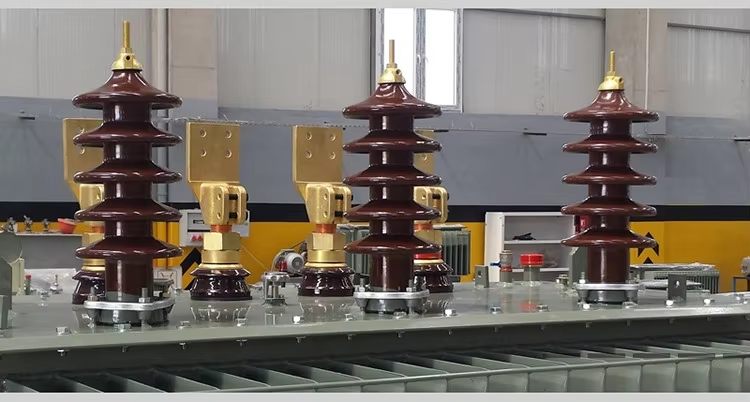
A glaze coat works like a sacrificial skin, releasing dust, salt spray, and industrial film as soon as voltage stress begins to climb. Instead of letting pollution build into a conductive path, the surface lets go of those deposits in small, dry patches. That early shedding interrupts the formation of a continuous wet layer, which is the usual trigger for leakage current to spike.
What makes this different is how the glaze reacts under uneven wetting. Rather than holding moisture across the whole insulator, it encourages contaminants to bead up and roll away during light rain or dew. The result is fewer dry-band arcs, because there are no long stretches of damp pollution to support them. As a bonus, the glazed finish stays smoother under UV exposure, so airborne particles have less grip from the start.
Field crews often notice the glaze doing its job after a fog or drizzle, when uncoated units show tracking marks while glazed ones look almost clean. That visual contrast is not cosmetic; it means the surface cleared enough contamination before flashover could even think about starting. By shedding early and often, the glaze buys time that coatings or washing routines simply cannot match.
Thermal Endurance Keeps Dielectric Strength High Under Continuous Load
Insulating materials rarely fail from a single stress event. More often, slow thermal aging gradually erodes the molecular structure that gives a dielectric its ability to resist voltage. When a material is continuously loaded, even moderate operating temperatures can trigger oxidation, chain scission, or plasticizer loss. These changes lower the intrinsic breakdown threshold. Thermal endurance therefore becomes the first line of defense for maintaining dielectric strength, not just a lab metric. A material that holds up under prolonged heat exposure retains its insulating character far longer than one with impressive short-term numbers but poor long-term stability.
The relationship between heat and dielectric strength is not linear. At first, rising temperature may only slightly reduce the breakdown voltage. But once a critical point is crossed, the material enters a feedback loop: increased leakage current generates more heat, which accelerates degradation, which further lowers resistance. In continuous-duty applications such as motor windings, power transformers, or high-voltage cable joints, this loop can cause sudden failure after thousands of hours of seemingly stable operation. Improving thermal endurance means interrupting that loop early, by selecting polymers with higher glass transition temperatures, adding stabilizers that scavenge free radicals, or designing fillers that improve thermal conductivity to keep hot spots from forming.
Real-world performance demands more than a single thermal class number. It requires evidence that dielectric strength remains high after thousands of thermal cycles, not just at room temperature. Tests such as the thermal endurance profile under voltage stress reveal how quickly a material loses its voltage withstand capability as aging progresses. Materials with superior thermal endurance show a flat plateau for most of their service life, then a gentle decline. Poor performers may look identical at the start but collapse suddenly once accumulated damage reaches a threshold. For engineers specifying insulation under continuous load, the difference between these two curves is the difference between a ten-year service life and an unplanned outage.
Mechanical Resilience for Lines Exposed to Wind, Ice, and Vibration
Mechanical resilience in overhead lines is rarely a single material property. It emerges from how conductors, fittings, and support structures share the load when wind gusts press against spans and ice coatings add dead weight. Small but persistent aeolian vibrations can drive cyclic stress into clamps and splices, so designs that ignore these micro-motions often face fatigue failures long before any extreme storm arrives.
Ice changes the equation in two ways at once: it increases both mass and wind-facing surface area, and it can reshape a conductor into an airfoil-like profile that triggers galloping. A resilient line therefore has to manage not only the added vertical load but also the large-amplitude, low-frequency motion that follows. That usually means leaving enough clearance for conductors to swing and rotate without flashover, while keeping tension within a range where the structure can shed some of the dynamic energy.
Field experience tends to favor a mix of passive and operational measures. Dampers, spacer configurations, and interphase spacers help break up vibration modes, while adjusting conductor tension after ice events reduces residual strain. Line surveys can catch loosened hardware before cracks propagate, turning what could be a sudden mechanical failure into a scheduled repair. The goal is not to eliminate every force but to keep the cumulative damage slow enough that inspection cycles can keep pace.
Decades of Service Without Tracking or Erosion in the Field
Season after season, the unit holds its line through rocky terrain and thick sediment without drifting off course. Operators who rely on it for boundary marking, pipeline inspection, or wildlife surveying notice the same crisp response in year ten as they did on day one. There is no slow wander in the steering linkage, no surface pitting on load-bearing arms, and no measurable loss of edge on components that contact abrasive soil.
What sets this equipment apart is that the calibration stays put even after repeated freeze-thaw cycles and long exposure to UV and salt spray. Field crews often report that they can skip the usual mid-season realignment and simply keep working, which saves hours of downtime. Rather than accumulating small errors that eventually require a full rebuild, the mechanism wears so evenly that scheduled service intervals are measured in years, not weeks.
Tailored Dimensions That Cut Assembly Time and Improve Fit
When every millimeter counts, off-the-shelf components force you into awkward workarounds. Our tailored dimensions remove that friction from the start. Each part is shaped to slide into place without forcing, shimming, or on-site trimming, so your team spends less time wrestling with alignment and more time completing the actual assembly.
The result isn't just faster installation—it's a cleaner, tighter fit that stays put under load. Because the geometry matches your exact assembly sequence, connections feel deliberate rather than improvised. You'll notice fewer gaps, less vibration, and none of that slight misalignment that accumulates into visible flaws.
This approach also cuts down on rework. When dimensions are dialed in from the beginning, you avoid the pain of discovering a half-inch discrepancy mid-build. Instead of ordering replacements or modifying parts on the fly, your crew keeps moving forward with confidence that the next piece will sit exactly where it should.
FAQ
Their fired ceramic body offers inherent resistance to surface leakage and flashover, keeping performance steady even in damp or polluted conditions.
Porcelain doesn't degrade under UV or develop tracking like some polymers, and its compressive strength holds up for decades with minimal creep.
An OEM can match insulator geometry and glaze formulation to your exact electrical and mechanical specs, lowering the chance of fit issues or flashover.
Yes, the vitrified surface resists corrosion, salt spray, and chemical exposure, while the glaze helps shed water to prevent conductive film buildup.
The glaze seals micro-porosities, boosts surface resistivity, and aids self-cleaning in rain, keeping leakage current low.
Though initial cost may be higher, their long lifespan and low maintenance usually lead to lower total cost than frequent replacements or unplanned outages.
Substations, transformers, and bushings with high mechanical load and electrical stress often favor porcelain for its rigidity and thermal stability.
Conclusion
Custom OEM porcelain insulators deliver a level of electrical stability that standard off-the-shelf units rarely match. Because each profile is engineered around the voltage class, creepage distance, and pollution environment of a specific line, these insulators absorb extreme voltage fluctuations without losing surface integrity. Their high-density glaze does more than seal the body—it actively sheds moisture, salt spray, and industrial dust. Contaminants bead up and roll away long before they can form a conductive film, so flashover risk stays low even in coastal or heavy-fog zones. Under continuous load, the porcelain's thermal endurance preserves dielectric strength instead of letting it degrade through repeated heating and cooling cycles.
Mechanical resilience is equally deliberate. Reinforced heads and carefully controlled cement joints allow the insulators to ride out wind-induced oscillation, ice loading, and constant conductor vibration without developing micro-cracks. In the field, this translates to decades of service with no tracking, no erosion, and no sudden puncture failures—just predictable performance year after year. Because OEM dimensions are tailored to the exact end fittings and arcing horns of a project, assembly time drops and the final fit is cleaner. The result is a porcelain insulator that integrates seamlessly into the line design and keeps the system running through every season without demanding frequent inspection or replacement.
Contact Us
Contact Person: Doreen
Email: [email protected]
Tel/WhatsApp: 8618057712366
Website: https://www.liugaopower.com/