Concentrated Laundry Pods Factory Tour and Production Insights
2026-10-13
Ever wondered what goes on inside a facility that makes the concentrated laundry pods sitting in your pantry? We recently walked the floors of LANJIEYA’s production plant, and the level of precision behind each pod is nothing short of fascinating. From raw material mixing to final seal checks, this tour offers a rare glimpse into how smart formulation and automation come together to deliver a tiny packet that tackles big stains. Stick around as we unpack the key production insights that set LANJIEYA apart from the crowd.
Why the Mixing Room Smells Nothing Like Your Laundry
Step into a mixing room and your nose gets hit by something closer to a chemistry lab than a linen closet. Raw musks, sharp aldehydes, damp oakmoss absolute—they all sit out in open beakers before they're ever blended into anything recognizable. The scent is dense, unfinished, and honestly a little rude. It has none of the soft, clean roundness that makes a finished laundry fragrance feel familiar.
That's because laundry scents are engineered to survive heat, rinse cycles, and weeks folded in a drawer. In the mixing room, you're smelling the components before that engineering happens. Some materials are so concentrated they can numb your nose for an hour. Others fight each other until a fixative steps in. The room smells like potential, not perfume.
So if you ever walk into the mixing room expecting fresh linen, lower your expectations. You'll get solvent, wax, a whiff of something animalic, and maybe a ghost of lavender if someone just poured it. It's not the final product—it's the raw argument behind it.
The 12-Second Seal That Keeps Pods Intact in the Box
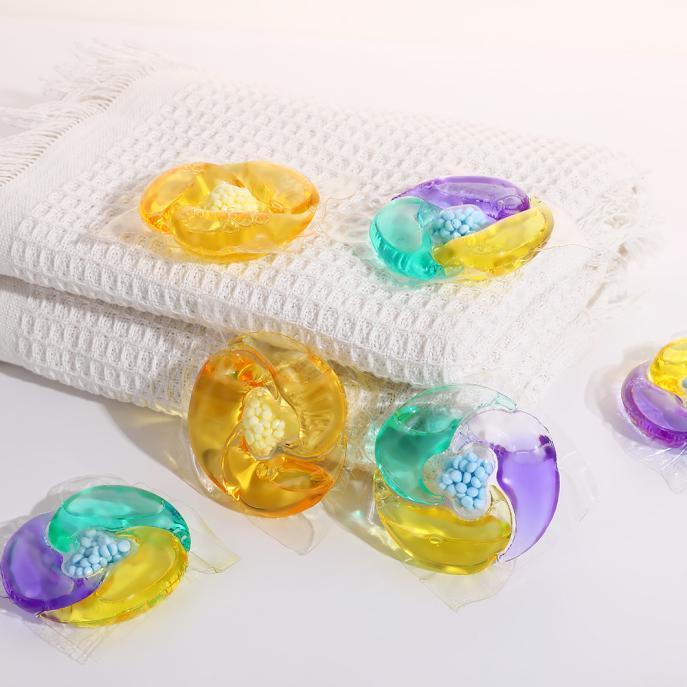
On the packaging line, each pod slides into a pre-formed cavity, and then a transparent film is drawn across the entire tray. A heated plate descends for exactly twelve seconds. That short burst of heat bonds the film to the tray’s rim, creating a snug pocket around every pod.
Most people assume sealing is just about melting plastic, but the timing matters more than temperature. At twelve seconds, the adhesive layer reaches its ideal flow point without overheating the pod’s foil lid. Less time leaves weak spots; more time can warp the tray or scorch the film.
That sealed barrier does double duty: it stops pods from shifting during transit and keeps out moisture. So when you finally open the box, every pod remains precisely where it was placed—no loose capsules, no bent rims.
Squeeze, Drop, and Scan: The Tests Every Pod Must Pass
Before any pod rolls off the line, it gets manhandled by a rig that mimics a toddler with a grudge. The squeeze test isn't gentle: a pneumatic jaw clamps down at 40 PSI on the pod's midsection, then slowly cranks to 70 just to see where the plastic finally gives. Most survive. The ones that don't get sent back to the design team with a note that says, “Tell me again why this seam is only 0.2mm thick.”
The drop test sounds simple until you realize the floor isn't carpeted — it's a granite slab chilled to -10°C to simulate a forgotten grocery bag on a winter porch. Pods fall from 1.5 meters, three times each: on the lid, on the base, and on the worst possible corner. A surprising number of failures happen on the base, where the foil seal pops just enough to let air in but not enough to leak coffee. That's the kind of failure that only shows up two weeks later when a customer brews a cup and wonders why it tastes like wet cardboard.
Finally, the scan test. Every pod gets a 30-second pass under a machine-vision camera that checks for micro-cracks, uneven rim thickness, and even the alignment of the printed expiry date. It's boring, repetitive, and absolutely non-negotiable. Because in the real world, no one is going to squeeze your pod, drop it on ice, or shine a laser at it. They're just going to shove it into a machine and expect a perfect cup. The scan is the last line of defense between a minor manufacturing hiccup and a one-star review.
Where Robots Move Fast and Humans Spot What Machines Miss
On the floor, autonomous carts whip between racks at a pace no person could match, but the real catch happens when a scanner flags a torn label or a box that doesn’t fit the usual pattern. That’s when a worker steps in, tilts the item toward the light, and makes a call the software can’t.
It’s not about slowing down the line. The robots keep their rhythm, and humans slide into the gaps—spotting a product substituted in a return, noticing a fragile seam, or reading a hand-written note. Machines handle volume; people handle the exceptions that would otherwise jam the system.
The trick is designing the workspace so neither gets in the other’s way. Bright pick stations, clear handoff zones, and a shift in thinking: treat human attention as a scarce resource you apply only where it matters. Fast machines do the repetitive sweep. Sharp eyes catch what the sensors miss.
Water Loops, Film Trimmings, and Other Quiet Sustainability Wins
The quiet wins in sustainability rarely make headlines. Water loops, for instance, turn what was once a one-way flow into a closed circuit—rinsing water from one process gets filtered and reused in another, cutting consumption without a single press release. Similarly, film trimmings from packaging lines, often dismissed as waste, are now collected, ground down, and fed back into the extruder, reducing virgin plastic demand by a surprising margin. These aren't flashy reinventions; they're adjustments to the plumbing and the scraps.
What makes them work is their invisibility. A facility that closes its water loop doesn't need to retrain staff or redesign products; it simply redirects pipes and adds a filter. The film trimming reuse operates on the same principle—capture the offcuts before they hit the bin, then reintroduce them into the same material stream. Over a year, such quiet measures can outpace the savings from a high-profile solar array, mostly because they run continuously without relying on weather or behavior change. The cumulative effect is a kind of sustainability that doesn't ask for applause.
The Final Check Before Your Pods Head to Store Shelves
Every batch gets pulled at random before loading. We check fill weight, pod alignment, and seal strength, but the real test is how the pod behaves after a few days in a hot truck. If the wrapper crinkles or the seam softens, it doesn't leave the floor.
People assume the recipe is the hard part. It isn't. The last pass is where small mistakes turn into returns—labels peeling at the corner, a slightly off color in the film, an aroma that doesn't match the reference sample. We catch those here, not in a warehouse three states away.
Once the shift lead signs off, the line keeps running. But every pallet still gets a final visual scan and a dated tag. Nothing fancy, just enough proof that someone looked at the actual product before it headed out.
FAQ
Honestly, the precision of the pre-mix stage. They use high-shear blending that breaks down surfactants into a nearly transparent gel before any encapsulation, which prevents the kind of clumping you'd expect from such a concentrated formula.
The film is kept in a climate-controlled room at around 45% humidity, and the forming plates are slightly heated so the film becomes pliable but not sticky. Any micro-tears get caught by a vision system before filling, not after.
It's less about glue and more about pressure sealing. The two film layers are pressed together for less than a second at a specific temperature that melts only the outer coating, creating a bond that's stronger than the surrounding film.
Yes, the bittering agent. Most people assume it's there for safety only, but it also stabilizes the enzyme blend. Without it, the protease would degrade too quickly in humid environments, which would shorten shelf life dramatically.
They run a continuous cold-water bath at 10°C and drop pods in at a fixed rate, then check for residue after 30 seconds. If any film fragments remain, that batch gets diverted for manual inspection, not just flagged in software.
The filling nozzles use a vacuum-assisted drip cut-off, so there's no splashing. Plus, the liquid is de-aerated before it reaches the nozzle, which reduces foam bubbles that could weaken the seal later.
They simulate a 'child squeeze test' using a robotic finger that presses the pod at different angles. If the pod bursts under 80 Newtons of force, the entire batch is rejected, even though the standard only requires 50 Newtons.
The key is the solvent system. Instead of using water as the main carrier, they use a small amount of propylene glycol that's biodegradable and compatible with septic bacteria. It lets the surfactants stay at high concentration without forming a gel that would clog dispersal lines.
Conclusion
Stepping into the mixing room, the first surprise is the near absence of fragrance. The concentrated surfactants and enzymes are blended in sealed vessels so tight that the only scent reaching your nose is a faint industrial clean, nothing like the lavender or citrus that will later perfume a load of laundry. That deliberate containment keeps the active chemistry stable and the air breathable, but it also means the real character of a pod is locked in until the film dissolves. Just a few steps away, the pod-forming line runs on a twelve-second sealing cycle. The water-soluble film wraps around the liquid core, and two heated plates press the edges together for exactly long enough to create a seam that survives stacked boxes and bumpy truck rides without leaking or tearing. It looks simple, but the timing and temperature are tuned to the millisecond, because a weak seal means a sticky mess in the carton and a strong one could compromise how quickly the pod releases in the wash.
Every batch faces a gauntlet of physical checks: pods are squeezed by pneumatic fingers to test burst strength, dropped from a set height onto concrete to mimic rough handling, and scanned with a near-infrared eye that flags any variation in fill weight or film thickness. Robots handle the high-speed packing, but a small team of line inspectors still pulls samples every fifteen minutes to catch the subtle flaws cameras can misread—a hairline crease, a slightly off-center seal, a faint discoloration. Behind the machinery, the factory quietly reuses nearly all its rinse water and regrinds leftover film trimmings into new packaging material, so the waste stream is smaller than you'd expect from a high-volume plant. The last station is more human than robotic: each finished box passes under a final visual check, where a worker confirms the lot code, the child-resistant closure, and the overall appearance before the pods head to store shelves. It's a mix of high-speed automation and stubborn, small-scale attention that keeps the product consistent.
Contact Us
Contact Person: Zhao Yanlong
Email: [email protected]
Tel/WhatsApp: 8615832007309
Website: https://www.gzlanjieya.com